

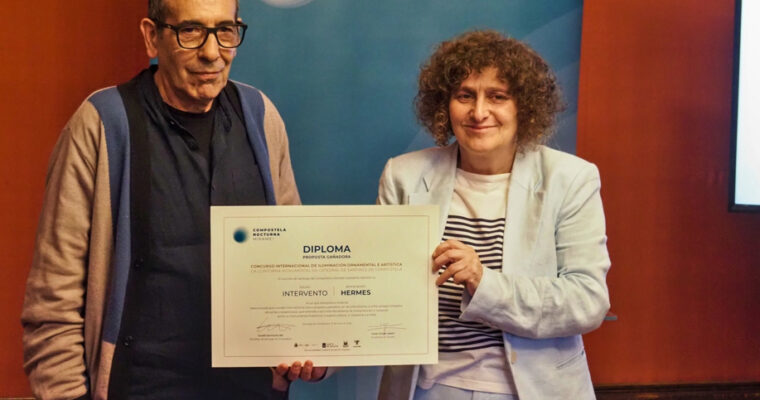
Santiago City Council and the three finalist teams — headed by the winning project, ‘Hermes’ — officially confirm the outcome of the competition with the presentation of the proposals and the award ceremony at the Pazo de Raxoi. From 19 to 31 May, the exhibition of the project “Compostela Nocturna, Mírame!” may be visited at the Casa do Cabido.
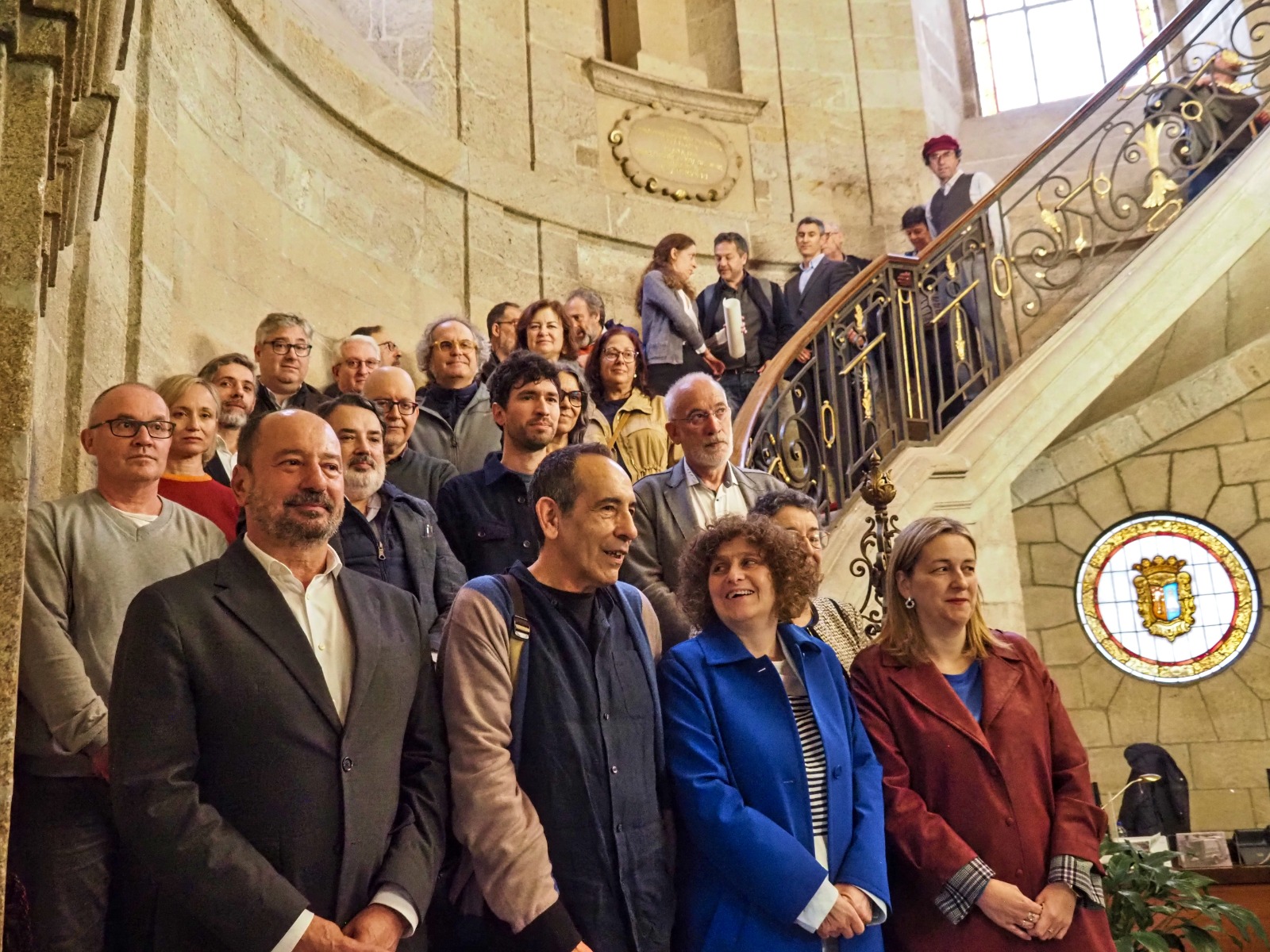
The Pazo de Raxoi hosted this morning the official presentation of the winning project and the award ceremony for the International Competition for Ornamental and Artistic Lighting of the monumental area surrounding Santiago Cathedral, “Compostela Nocturna, Mírame!”. The event served to recognise the work of the three finalist teams and to present both the finalist proposals and the project that will form the basis for the future lighting of the heart of the historic city, beginning with the lighting works in Praza das Praterías.
The award ceremony, chaired by the Mayor, Goretti Sanmartín Rei, was also attended by the Director of the Galician Tourism Agency, Xosé Manuel Merelles; the representative of the winning team, Miguel Ángel Lorite; and the representative of the competition’s technical office, Cecilia Pereira.
In her speech, Goretti Sanmartín congratulated the three finalist proposals and thanked all the members of the jury for their work and commitment. She explained that “the lighting proposal we are awarding today is in line with our aim of developing a pioneering lighting project, one that is suited to the needs of our heritage, to this city’s environmental conditions, and that respects the delicacy and subtleties of the Compostelan night”. The Mayor concluded by expressing her wish that “this night-time lighting should become an additional attraction for all of us who have the good fortune to live in Compostela, for the people of our surrounding area, and also for those who visit us and wish to extend their stays and experiences here”.
For his part, the Director of the Galician Tourism Agency also emphasised the calibre of the members of the “jury of experts, all of recognised prestige”, and stated that it was “a pleasure to see the outcome of the competition”, given the boost it will provide to Santiago de Compostela’s Tourism Sustainability Plan. In this regard, he also said that “it is a perfectly defined plan for Compostela’s needs”.
Miguel Ángel Lorite, from the studio Intervento, received the first prize for ‘Hermes’, a proposal that scored 95 points out of 100 in the competition. The jury considered it a comprehensive, efficient, respectful and viable contribution, particularly valuing the fact that it resolved the ornamental lighting without installing new elements on the Cathedral’s roofs. Miguel Ángel Lorite first highlighted the importance of holding competitions of this nature and then focused on the conceptual parameters that define the project. He explained that they understand artificial lighting as “a language”, through which they will seek to alter both the monumental ensemble and the night sky as little as possible, creating “a visual atmosphere designed for local residents, offering a night-time walk for the people who live here, placing small accents on things that often go unnoticed, or that once existed and no longer do, on elements of vernacular architecture or those linked to the imaginary”.
The other two finalist teams — the Finnish studio Valoa Design and the Italian team led by Studio Piero Castiglioni, together with Marco Petrucci and F&M Ingegneria — took part remotely through videos in which they presented the main features of their proposals and expressed their appreciation for the recognition received in the competition.
A test model in Praza das Praterías
Those attending then moved to Praza das Praterías, the space that will host the pilot project for the intervention. As the technical managers explained, this square will serve as a testing ground due to its characteristics as a complex civic space with two platforms and a wide diversity of uses, allowing the behaviour of the light to be assessed before it is extended to the rest of the monumental area.
The project proposed by Intervento is based on an interpretation of urban morphology and construction history, conceiving light as an additional layer of the space: integrated, reversible and respectful of its daytime perception. The lighting is structured through a hierarchy in which the main elements receive a gradual and controlled presence, while secondary elements remain at lower levels, favouring smooth transitions.
The proposal pays particular attention to visual continuity between squares and routes. The result is a balanced, legible and sustainable night-time landscape, in which lighting acts as a tool for interpretation and connection, contributing to a more conscious relationship between heritage, the city and the night.
Exhibition and visit schedule
Following the award ceremony, the exhibition detailing the process and results of the competition was inaugurated on the lower floor of the Casa do Cabido, within the Praterías area itself. The exhibition consists of nine panels describing the competition process, contextualising the origins of artificial lighting in the city, explaining the chosen procedure, the composition and work of the jury, and the various criteria assessed. It also analyses the broad international participation, the conceptual ideas of the finalist proposals, and describes the next stage: the launch of the pilot project in Praza das Praterías.
Members of the public may take part in guided visits to the exhibition on 21, 26 and 28 May at 6.30 pm at the Casa do Cabido, with no prior registration required, subject to capacity. The exhibition will subsequently move to the Casa das Asociacións de Cornes from 1 to 8 June. In this case, two free guided visits are planned for Tuesday 2 June, in morning and afternoon sessions, at 12 noon and 6.30 pm respectively.
Tourism Sustainability Plan
This competition forms part of the Santiago Tourism Sustainability Plan, promoted by the Government of Spain, the Xunta de Galicia and Santiago de Compostela City Council, with a total investment of €3 million for sustainable transformation projects.
The initiative is one of the Plan’s central actions and represents a commitment to innovation applied to heritage, aligned with a more sustainable tourism destination model that is respectful of the historic city. Technical assistance and coordination of the competition were provided by the Compostela-based company TRIVIUM.