
Compostela nocturna, mírame! Vivir a cidade, iluminar a historia
Concurso Internacional de Iluminación ornamental e artística da contorna monumental da Catedral de Santiago de Compostela
THE HOUSE OF THE APOSTLE: LUMINARIA, STAR, AND LAMP
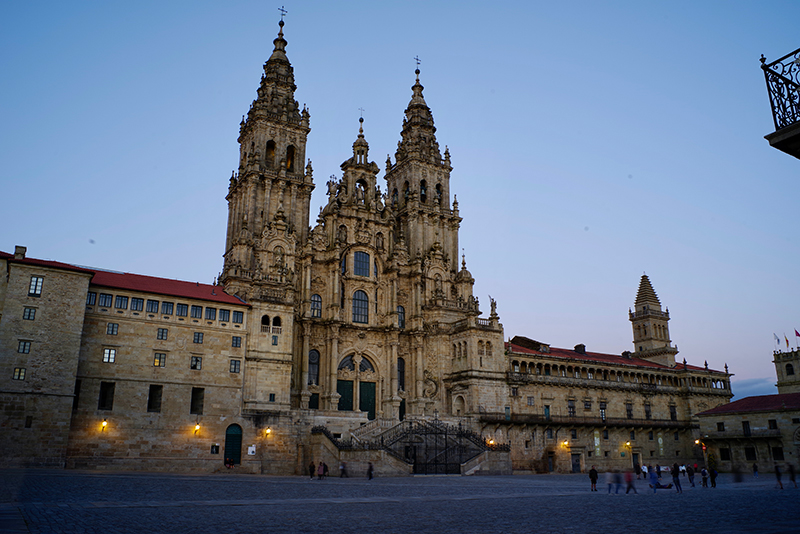
The Cathedral of Santiago is a gigantic mass that rests in the heart of the town, on a cemetery area that gave rise to present-day Compostela. From the beginning, the monument has been associated with miraculous lights. First, there were the lights –luminaria– that indicated the place where the aedicula identified with the tomb of Saint James the Great and his disciples was located; later, with the success of the Jacobean pilgrimage, the Saint James Way became a Way of Stars -the Milky Way- leading to Compostela. In this way, an old and gloomy cemetery –compositum tellus– was transformed into a splendid and luminous Campus Stellae.
The transformation of a non-place into one of the wonders of the West owes much to the metamorphoses of the apostolic basilica, which, like a star, extends its arms towards the city, creating a series of squares that form a spectacular urban ensemble that connects the sacred and the profane. If Acibechería, the old Porta Francíxena, with its end at Inmaculada’s Square, marks the end of the French Way and was in the past a bustling place where scallops and gourds were sold; Praterías, with its palimpsest façade and jewellery shops, was originally the bishop’s gate and the entrance for triumphal processions. For its part, the Quintana, in its stony and monastic solemnity, hides under its slabs the old city cemetery and is stepped on in jubilee years by hundreds of pilgrims queuing to enter through the Holy Door, while the Obradoiro is pure baroque artifice that looks impassively at the history of the city at its feet, with the old Royal Hospital, the Raxoi Palace and the Rectorate of the centenary Minerva of Compostela.
In this peculiar granite constellation, Compostela – declared a World Heritage Site in 1985 -remains, as Valle-Inclán pointed out in “La lámpara maravillosa”, “una ciudad petrificada que huye la idea de Tiempo” (a petrified city that flees the idea of Time) that does not seem old, but eternal. Lighting this immemorial glow and keeping these lamps burning is now, more than ever, a collective task and a challenge for the future.
Manuel Antonio Castiñeiras González
President of the International Committee of Experts on the Camino de Santiago.
Full Professor of Art History, Universitat Autònoma de Barcelona
Nighttime Compostela, look at me! Live the city, illuminate the history
International Competition for Ornamental and Artistic Lighting of the Monumental Surroundings of Santiago de Compostela’s Cathedral
CONTACT
comunicacion@trivium.gal