
This company, a pioneer in lighting urbanism and heritage lighting, will be responsible for drafting the executive project and overseeing the pilot works in Praterías Square after achieving the highest score.
The jury highlighted the high standard of the competition and the quality of the finalist proposals, submitted by the Finnish studio Valoa Design and a team led by the Italian designer Pietro Maria Castiglioni.
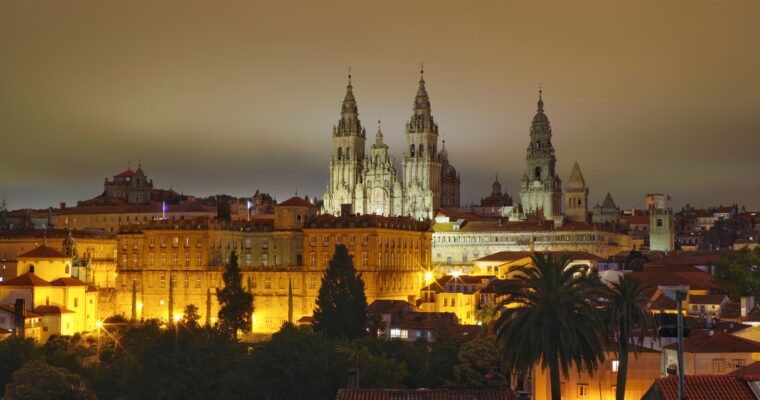
Santiago de Compostela, 18 February 2026. – The international jury of the International Competition for Ornamental and Artistic Lighting of the monumental surroundings of the Cathedral of Santiago de Compostela unanimously agreed to select as the winning proposal the preliminary design submitted under the motto “Hermes”, which achieved the highest overall score in the final phase.
The decision was taken at the meeting held on 3 February, during which the jury assessed the three finalist preliminary designs in accordance with the criteria set out in the competition rules: value and quality of the lighting design, technical and economic feasibility, and environmental protection, energy efficiency and technological innovation. The decision was published on the Public Sector Procurement Platform, in compliance with the legal requirements established in the competition.
Once the envelope containing the administrative documentation was opened, the motto was found to correspond to the studio Intervento, which will be responsible for drafting the executive project and assuming the site supervision of the pilot lighting works in Praterías Square. This intervention is conceived as a testing ground for future progressive implementation throughout the cathedral precinct, including Obradoiro, Quintana and Inmaculada squares, as well as the connecting spaces between them.
The highest-rated proposal by the jury
The preliminary design “Hermes” (Intervento) achieved a total score of 95 points out of 100, compared with the 65 points obtained by the other two finalist proposals. Broken down by category, the winning proposal received 45 out of a possible 50 points for the value and quality of the lighting design and achieved the maximum score in both the technical and economic evaluation, on the one hand, and environmental protection, energy efficiency and technological innovation, on the other: 25 out of 25 in each case.
According to the minutes, “the preliminary design offers a very precise analysis of the architecture and the urban and historical context of the area of intervention”. The jury highlighted that the proposal presents a lighting design characterised by “clarity and integrity, proposing a balanced image of the nocturnal landscape while avoiding homogenisation through the hierarchical organisation of lighting, using gradients and contrasts that enhance the architecture without distorting it”.
Likewise, the final decision places particular value on the intelligent use of penumbra and light-and-shadow contrasts, not only in the ornamental lighting of the monuments but also along the routes through the surrounding public space, providing coherence to the proposed solution.
Maximum respect for the cathedral heritage
One of the decisive aspects considered was the strategy of minimal intervention in relation to the heritage. The minutes explicitly state that “Hermes” is the only proposal that resolves the ornamental lighting of the cathedral complex without installing new equipment on the stone roofs, which have recently been fully restored.
In this regard, the jury underlined that the project “guarantees the conservation of the cultural values of the cathedral as a whole, including the roofs”, which form part of the visitor route and enjoy the highest level of protection as a Property of Cultural Interest.
Technical and economic feasibility and sustainability
From a technical and economic standpoint, the jury concluded that the proposal is “technically very complete”, highlighting the precision of the calculations, the lighting levels and the colour temperatures, which were considered “well chosen”.
The use of luminaires from different commercial brands was also positively assessed, as it “favours the economic sustainability of the proposal and even its long-term maintenance”. The budget submitted includes all phases of the intervention — dismantling, installation and testing — and is considered balanced and viable, allowing the quality of execution to be ensured.
In environmental terms, the proposal is structured around the principle of “integration and minimal intervention”, with precise control of light beams designed to prevent glare and reduce light pollution, preserving the desired darkness of the sky and the nocturnal landscape. The jury noted that the project quantifies an estimated energy saving of approximately 68% compared with current consumption, while also acting on buildings that had hitherto lacked ornamental lighting.
High quality and suitability of the finalist projects
Alongside the winning proposal, the jury highlighted the quality of the other two finalist preliminary designs. In this respect, “Shh… See the silence” — submitted by the Finnish studio Valoa Design — was valued for its conceptual coherence and for its use of light and penumbra in keeping with the spiritual atmosphere of the site. “Ad Maiora Semper” (the motto behind which stood a team led by Pietro Maria Castiglioni, a.k.a. Piero) was recognised, among other aspects, for its exhaustive historical and urban analysis and the high level of development of its technical and economic proposal.
Within the framework of the Santiago Tourism Sustainability Plan
The International Lighting Competition forms part of the Santiago Tourism Sustainability Plan (PSTD), promoted by the Government of Spain, the Xunta de Galicia and the Santiago de Compostela City Council, with a total investment of €3 million for sustainable transformation projects. The initiative constitutes one of the Plan’s core actions and represents a commitment to innovation applied to heritage, aligned with a more sustainable and respectful tourism destination model for the historic city. Technical assistance and coordination of the competition were provided by the Santiago-based company TRIVIUM.